Imagine this: a classroom where all your learners, regardless of language level, are engaged and actively participating with one another and the content. Supporting English language learners in the classroom is a crucial step in creating an environment that is inclusive of all students. As educators, we strive to meet the diverse needs of all our students, which can often feel overwhelming. With curriculum demands and limited prep time, sometimes it feels impossible.
I’m going to share 5 strategies for supporting English language learners in the classroom in order to create a more inclusive, confident, and language-rich classroom. These strategies don’t create more prep, but do require a thoughtful approach to make each lesson more impactful for your learners. Our ultimate goal is a classroom where our English language learners feel safe, included, and engaged in the curriculum. To be honest, these strategies will also be supportive of all your students —a bonus!
Honoring the Culture of Your English Language Learners
Why is it important to integrate students’ home language and culture into the classroom? It makes students feel seen, safe, and valued. It sets the tone for an inclusive environment where diverse backgrounds are acknowledged and honored. Students who feel important are much more likely to engage with the content and take risks.
In languages that reflect your student demographic:
- Post classroom labels.
- Have a library of books- not only in other languages, but also about countries where your students are from.
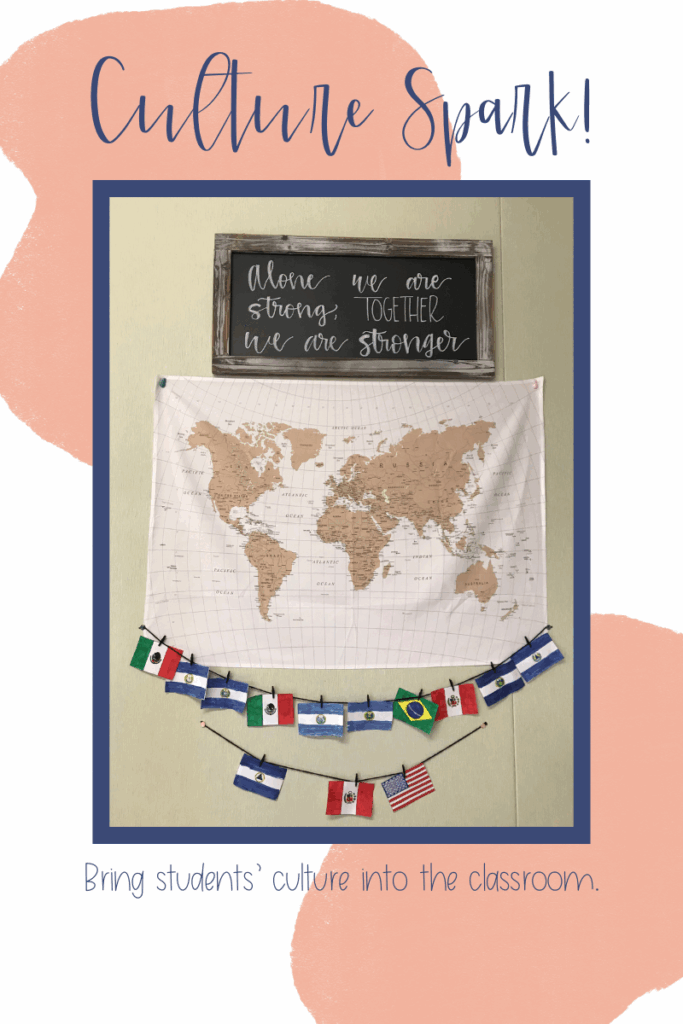
- Display a world map with students’ names connected to their native country, OR
- Display a world map and have students color the flag of their native country, then create a banner underneath.
- When co-constructing anchor charts with students, have students share key vocabulary words in their home primary language. They can write the word(s) on a sentence strip and tape it next to the English word on the anchor chart.
- If helpful to their learning, allow students to use their home primary language when working in collaborative groups and when processing information.
- Integrate activities that support your students in sharing about their culture.
- Weekly, or 1-2 times a month, highlight a different culture. This is important for your students’ cultures to be represented, but it is also an opportunity to teach all your students about new cultures that are not represented in your classroom. Include simple items like the flag, greetings, a song that represents the culture, photos of food, clothing, etc. You’re just creating exposure.
- Pronounce your students’ names correctly and take ownership when you get it wrong. This is something near and dear to my heart, as someone with a unique name.
- “It’s really important that I pronounce my students’ names correctly. Can you please say your name for me, and then I’ll repeat it back to you? Did I get it right?”
- “Teach me your name. Did I say that correctly?”
- “I’m so sorry I mispronounced your name. Names are really important to our identities. I need some practice. Would it be okay with you if I tried again?”
- When in doubt, ask for support from students and their families to help you bring in aspects of their culture and to ensure you’re getting it right.
Finding ways to honor the culture of your students is crucial for supporting English language learners in the classroom.
Building Background Knowledge for English Language Learners
Activating and building background knowledge is essential in supporting your English language learners in the classroom. Building background knowledge is like building a bridge between what students know and what they’re about to learn—it connects the unfamiliar to the familiar, making new content meaningful, memorable, and accessible. I’ll list a variety of ways to support this, but the biggest piece that comes to mind is structuring your curriculum so that you are teaching units of study from your science and social studies standards and not reading isolated stories each week. A unit of study lasts anywhere from 4-6 weeks and gives students an opportunity to build knowledge on one topic. This supports vocabulary development, reading comprehension, and writing! Tell me those aren’t three areas we are always trying to improve! When we give students time with content, they are better able to read about it, talk about it, and write about it because they are building knowledge over time.
Some additional tools and ideas to help you:
- Use visuals and give students time to observe, ask questions, and make predictions about photographs from the units of study, draw sketches, or bring in realia.
- Picture sorts
- Observation Charts
- Read Alouds
- Videos
- Graphic organizers and anchor charts to support activating and building background knowledge
- Inquiry Charts (GLAD Strategy)
- This is a modified KWL with only columns for the K and W. As students engage with the content, you revisit the chart and confirm or correct the K column and answer the questions in the W column.
- Graphic Organizers to Build Background Knowledge
- Inquiry Charts (GLAD Strategy)
- Incorporate songs and chants
- {Free} Picture Dictionary
Provide Visuals for English Language Learner Students
Visuals are an essential strategy for all content areas to support your English language learners. Visuals reduce the language load, provide clarity to students, simplify high-level curriculum without taking away rigor, and unlock access for all students, regardless of their language proficiency levels. This is why it is especially important to show videos before and during units of study and incorporate photographs or sketches for high-level academic and content vocabulary, schedules, and objects around the room. Co-constructing anchor charts with students can be invaluable because they create a visual poster for concepts.
Collect photographs for your units of study and laminate them or keep them in sheet protectors so that you can use them year after year. You can slowly build your visual library for each unit of study that aligns with your standards over time. When you co-construct anchor charts, sketch them out in pencil so that you’re not trying to remember your goal as you’re teaching. In addition, write any notes that will be helpful for you so that you don’t forget to cover the important information during your lesson.
Provide Sentence Frames for English Language Learners
Sentence starters, sentence frames, and accountable talk cards can give students scaffolded support when speaking and writing. These are impactful in supporting English language learners in the classroom. They give entry points for students to express their thinking. This is especially helpful in building confidence and empowering students in their speaking and writing. You can include the specific language that you want students to use and practice in these frames, and you can also differentiate them by proficiency levels.
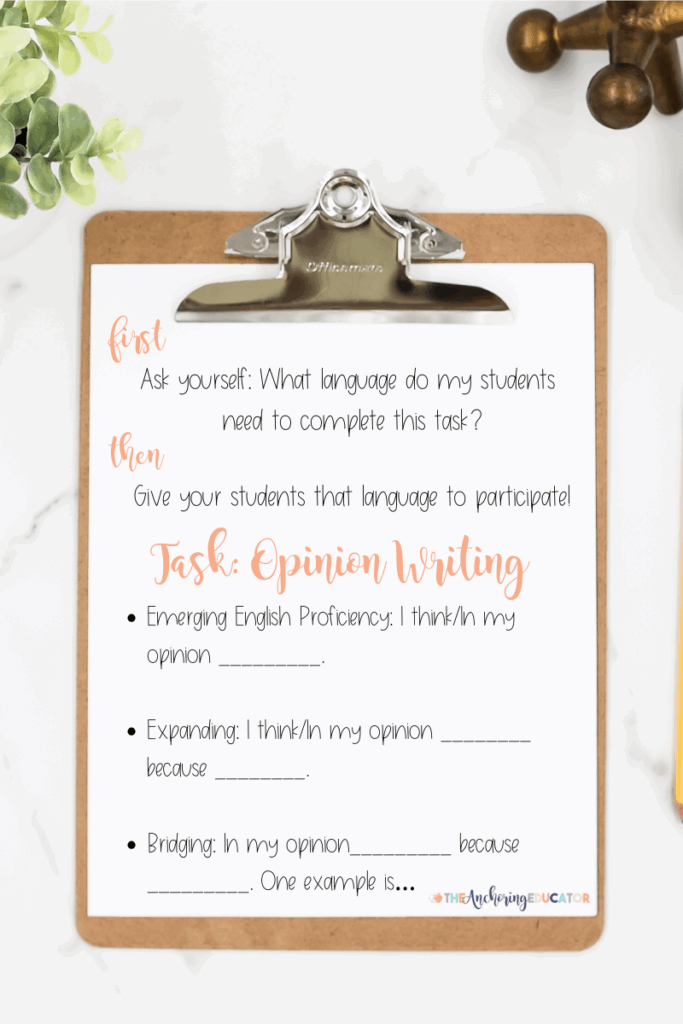
The beautiful thing about providing sentence frames for English language learners as a scaffold is that it is there for them to use if they need it. If they don’t need it, they don’t have to use it!
When thinking about what kinds of sentence frames/starters to provide, think about the language demands of the task that you are asking your students to complete. What language will they need to participate in speaking and writing about this topic? Then, give them that language so that they can successfully participate!
Resources to support you:
- Graphic Organizer PDF Templates for Reading Literature with Sentence Frames
- Mini Graphic Organizers Templates for Reading Literature (includes sentence frames) to use for Writing Journals
- Accountable Talk Resource Cards
- {Free} Making 10 Activity: A Fact Fluency Game that includes sentence frames
- All other resources listed in this blog also have sentence frames to support student speaking and writing: All About My Name, All About My Identity, All About My Culture, BUNDLE with all 3 resources, Observation Charts.
Create a Collaborative Learning Environment
Creating a collaborative learning environment that feels safe and encourages students to take risks is going to be so effective in supporting your students in reading, listening, speaking, and writing. Collaborative strategies in teaching students can change the dynamic of your classroom if they are structured and consistent. Structured partner work, group work, and community building create a place where students know they don’t need to have all the answers, they can make mistakes, and they can struggle without feeling helpless and giving up. Collaborative environments celebrate many ideas, teach students how to problem solve, negotiate, share their ideas, and listen to the ideas of others. In a collaborative learning environment, students feel safe, supported, and like they belong.
The key to any collaborative learning environment is to create structures or routines so students know what to expect. Productive partnerships and group work will not happen overnight. Students need time to learn how to engage with each other and need to feel like an essential part of the classroom to show up for their team. I go into more depth on this in these three blog posts: 5 Simple Steps to Help You Use The Pair Sharing Strategy Effectively, How to Launch Collaborative Groups to Get ALL Students Learning, and 3 Effective Strategies to Promote Discussions in the Classroom.
Supporting English language learners in the classroom with intentional scaffolding does not require you to recreate the wheel. By honoring the culture of your multilingual learners, activating and building background knowledge, providing visuals and sentence frames, and creating a collaborative classroom environment, you can make small shifts that lead to big gains. These strategies empower students and make them feel safe, valued, and willing to engage in rigorous content.
Articles and Resources to Further Support You
- Supporting English Language Learners: Resources for Educators and Administrators
- NEA: English Language Learners: What you need to know
- The Kinder Led Teacher: Classroom Labels in English/Spanish
- Crayons and Creating Visual Supply Cards